DECISION FRAMEWORK

The real NB-IoT story is not range

Choosing a communication technology is not a contest over which one reaches furthest. For a water utility the real question is how a device fleet will be managed for the next ten years.

START WITH THE RIGHT QUESTION

The wrong question: “which one reaches further?”

Coverage is only one component of the technology decision. There are cases where all three technologies work at difficult installation points, and cases where each needs extra work at weak points. Coverage is an item to measure, not a claim of superiority on its own.

The right question is this: who will manage a device fleet that stays in the field for ten years, with what tooling and at what cost? That question puts infrastructure ownership, bidirectional communication, data volume and the firmware lifecycle on the same table.

For a utility, the real value of NB-IoT is that it leaves the operating responsibility for a licensed cellular network with the operator, and that bidirectional communication makes remote device management possible.

TECHNOLOGY COMPARISON

Three technologies, the same questions

The table below is a neutral decision framework showing general characteristics of the technologies. It makes no claim about any specific vendor's product.

Sigfox

Ultra-narrowband, very low-power messaging.

Network ownershipOperator / unlicensed band
Data volumeVery small messages
Bidirectional communicationLimited
Remote firmwareNot practical
Infrastructure burden on the utilityLow

LoRaWAN

Usually a model where the utility builds its own network.

Network ownershipMostly the utility's own network
Data volumeSmall to medium
Bidirectional communicationDepends on device class
Remote firmwarePossible, depends on network design
Infrastructure burden on the utilityHigh: gateways, backhaul, maintenance

NB-IoT

A managed device on a licensed cellular network.

Network ownershipMobile operator (licensed)
Data volumeLarger payload
Bidirectional communicationYes
Remote firmwarePart of the design
Infrastructure burden on the utilityLow: the network sits with the operator

The statements above summarise the general behaviour of technology families. Real performance depends on operator configuration, band, power-saving timers, device design and the installation point. A definitive comparison is only possible through measurement in the same location.

COMMON MISTAKES

What NB-IoT is not

The three topics most often misread in specifications and tender evaluations.

01

It is not “guaranteed signal everywhere”

NB-IoT is a profile designed with deep indoor installations in mind, but it does not guarantee identical signal quality at every point. Difficult points are measured, not assumed.

02

It is not free of commercial dependency

Avoiding a gateway removes the infrastructure burden; it does not remove the SIM/eSIM subscription, the operator contract or, where required, a roaming agreement.

03

It does not bring standards conformity by itself

NB-IoT is a transport technology. The data model and interoperability are a separate matter, which is why DLMS/COSEM is treated as its own roadmap item.

TENDER EVALUATION

Six questions to ask before choosing a technology

The answers vary by project. We do not offer one “right answer” on this site; we offer a comparable evaluation framework instead.

  • Who will operate the network infrastructure for ten years, and who carries fault responsibility?
  • When a firmware update is needed, do we have to return to every single meter?
  • How many data fields do we need, how often, and which decision does that feed beyond billing?
  • Who authorises valve and configuration commands, and how are those records retained?
  • Have band suitability and roaming coverage been validated in the target country and operator?
  • Into which platform and format will the data flow, and how is it migrated when the contract ends?
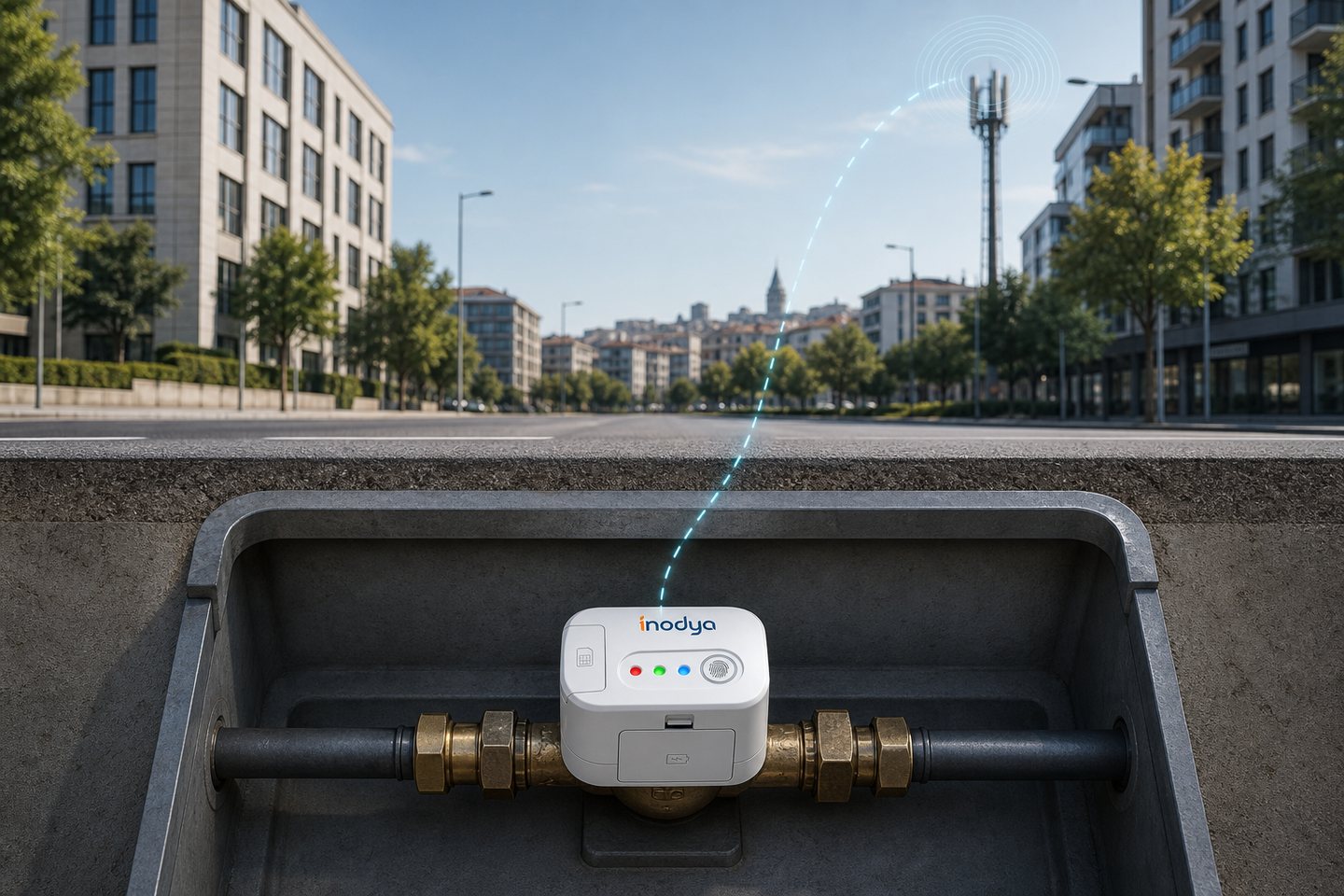
A smart water meter installed in a meter chamber beneath a city street.

NEXT STEP

Start by measuring in your own network

Let us validate the coverage, data, battery and integration assumptions together in a limited pilot. We write the success criteria before the pilot begins.