
Field cost
If a firmware or configuration change means returning to the meter, operating cost overtakes device cost as the fleet grows.
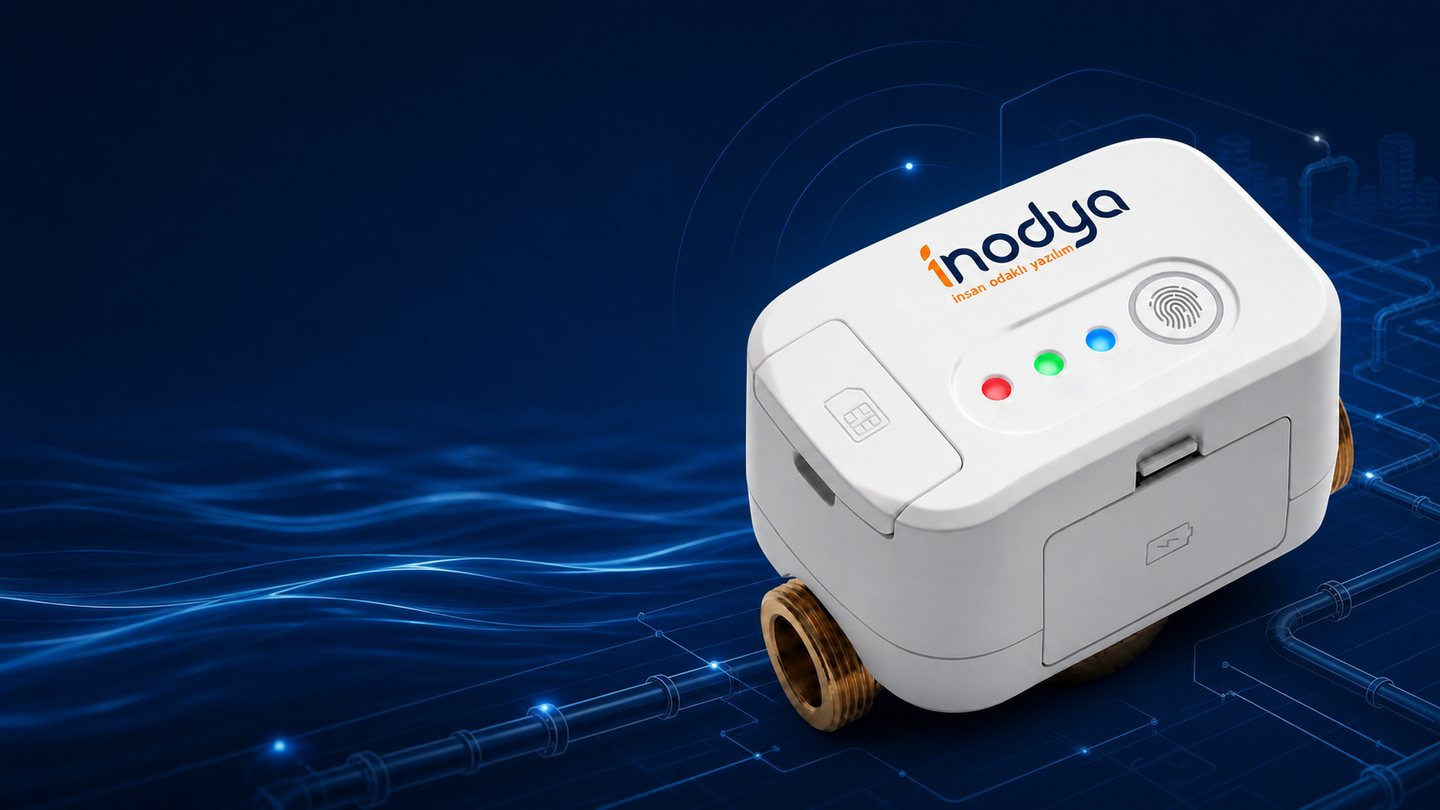
Orion NB-IoT SMART WATER METER
Move water-meter operations from the field to the control room with multi-band NB-IoT connectivity, remote firmware management and richer data packages.
Band and operator compatibility is validated for each target market.
Only capabilities verified by the product team are listed here. Topics such as certification, band lists and battery life are validated separately for each project.
THE UTILITY AGENDA
Remote reading on its own does not solve non-revenue water, billing accuracy or field cost. A smart metering investment has to be assessed together with data frequency, device management and event visibility.
If a firmware or configuration change means returning to the meter, operating cost overtakes device cost as the fleet grows.
Small payloads and infrequent transmission mean abnormal consumption and tamper events surface only at the end of a billing period.
When gateway, device, SIM and platform are managed separately, the responsibility boundary blurs and nobody owns the fault.
0%
Average drinking-water loss in Türkiye (2021)
Source: Water Efficiency Strategy Document and Action Plan, Ministry of Agriculture and Forestry
0%
Non-revenue water rate (2021)
Source: Water Efficiency Strategy Document and Action Plan
0%
2028 water-loss ceiling for metropolitan and provincial municipalities
National target; the 2040 target is 10 percent.
0networks
Commercial NB-IoT networks listed worldwide
Source: GSMA, November 2025 update
ARCHITECTURE
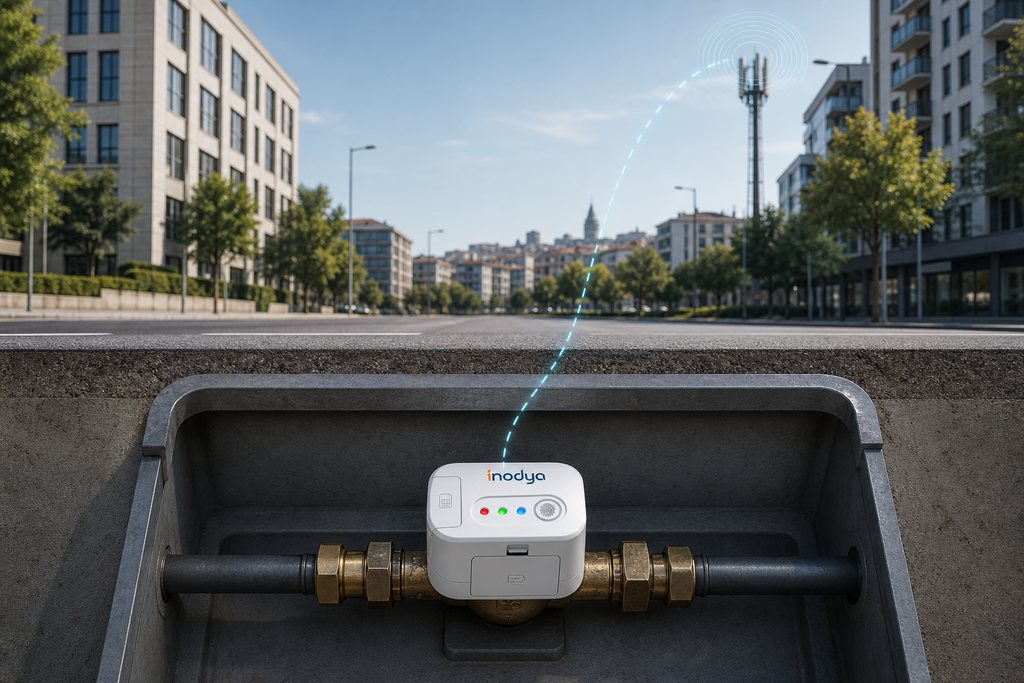
Orion NB-IoT connects directly over existing mobile operator infrastructure. Click any link in the chain to see what it does.
Needing no gateway does not mean there is no commercial dependency: the SIM/eSIM subscription, operator coverage and, where required, a roaming agreement are part of the project.
INSTALLATION AND COVERAGE
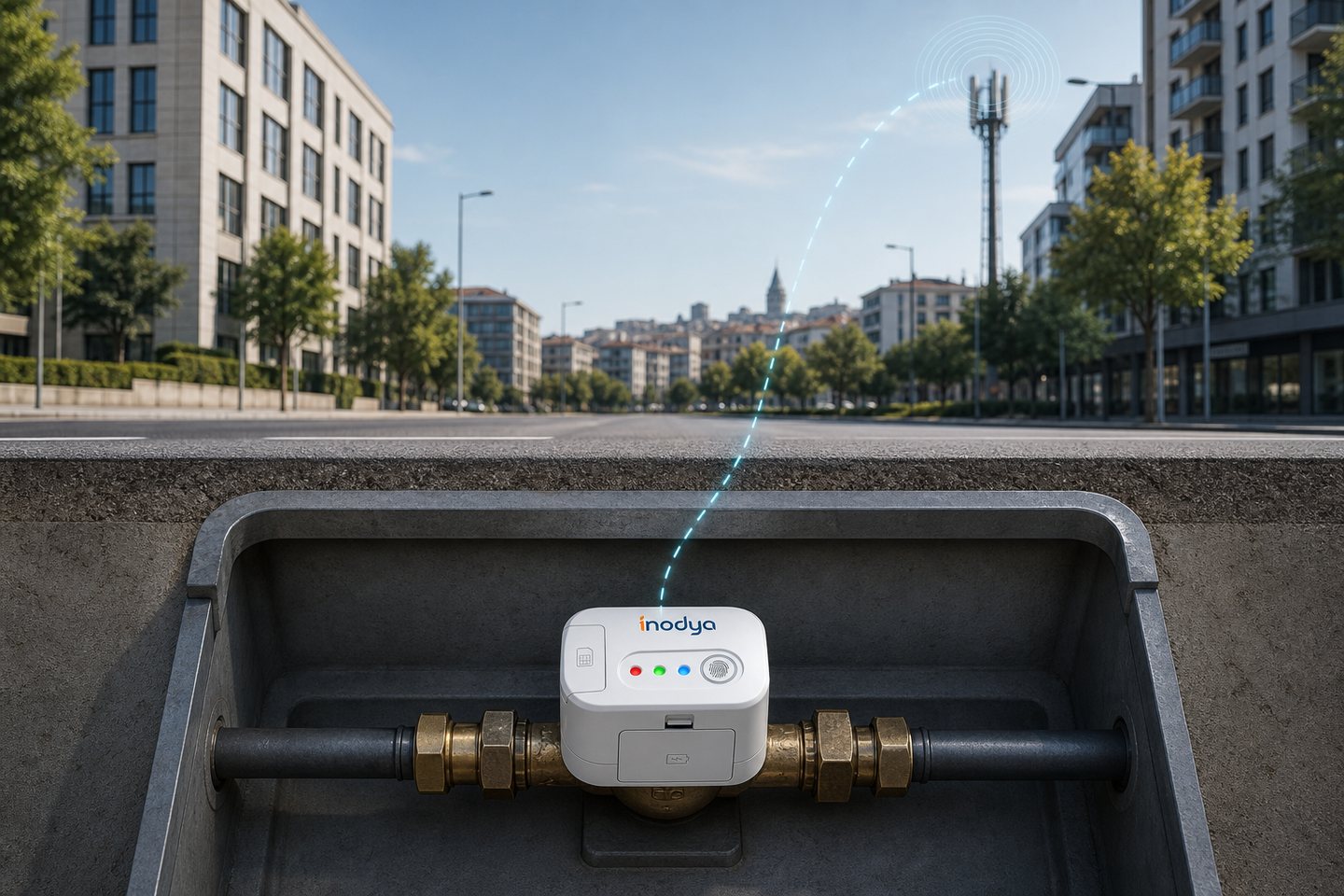
A significant share of meters sit in underground chambers, basements and concrete pits. NB-IoT is a cellular profile designed for these conditions — but coverage is still not identical at every point.
Chamber depth, cover material and concrete thickness affect the signal directly. Difficult points should be treated as a separate class during the pilot.
The same device can deliver markedly different signal quality when the antenna orientation and position change. The mounting guideline is applied together with the installation crew.
The band in use varies by country and operator. The device hardware is designed to be adapted to different profiles; exact suitability is validated in the project country.
In weak signal the device transmits at higher power and for longer. Battery-life estimates are always given together with transmission frequency and measured signal quality.
DATA
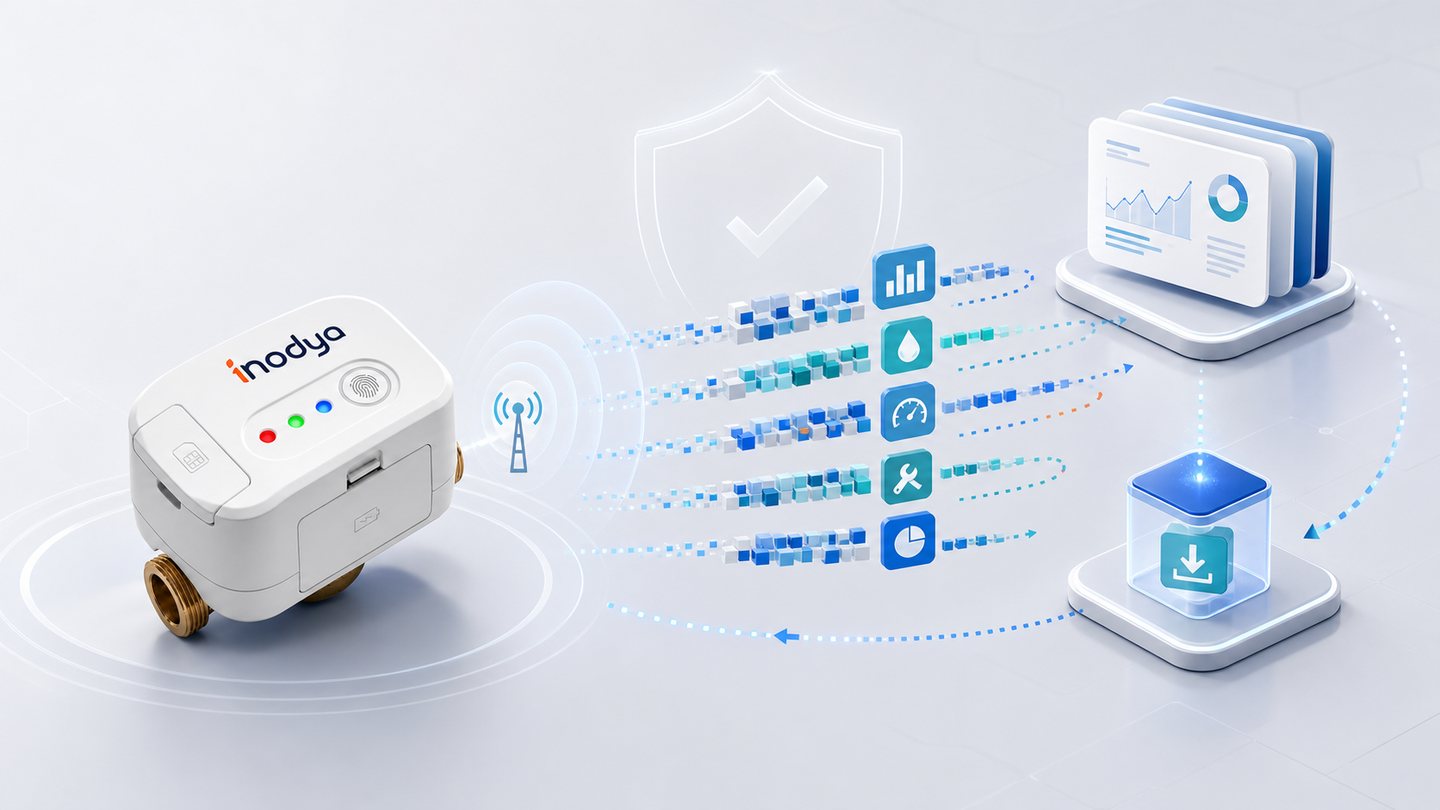
NB-IoT connectivity carries richer and more frequent data than narrower-band alternatives. The groups below show the data families the meter produces.
The basis for billing and trend analysis.
Flow behaviour for leak investigation and meter sizing.
Situations the field team needs to prioritise.
The device's own status, for planning fleet maintenance.
Traceability for authorised remote control.
Field names, units and transmission frequency depend on the project configuration. The exact data dictionary is shared with the technical file, tied to a specific release and configuration.
REMOTE DEVICE MANAGEMENT
Remote update is not explained by saying it exists. What matters is how the rollout is staged, what the device does if it is interrupted, and how the result is tracked. The flow below walks through a representative rollout.
The firmware package is built, release notes are written and target hardware and configuration eligibility is defined.
The rollout runs first on a small, representative group of devices, chosen to include both easy and difficult coverage points.
The device checks that the package it downloaded is intact and applicable to itself; if it is not, the update is not applied.
If the pilot result is accepted, the rollout grows in waves. A failure-rate threshold is monitored in every wave.
If connectivity or power is lost, the device does not apply the update and stays operational; the rollout is retried.
Version spread, success rate and the list of devices needing a field visit are followed from a single screen.
The figures on this panel are illustrative and are not a performance commitment. Technical detail and verification records for the rollout are shared in the technical file.
THE ORION DIFFERENCE
A full shut-off is not always the right tool. Moving the valve to an intermediate opening offers a more useful option in drought management, prepayment and social-policy scenarios. Try the slider.
Important: the slider shows valve opening, not flow rate. Because of network pressure, pipe diameter and installation resistance, a 50% valve opening does not mean 50% flow. The real hydraulic effect of each throttling level is measured under project conditions.
During restrictions, graduated throttling instead of a full shut-off can preserve access to basic water supply.
Different opening policies can be applied to specific customer groups or facilities, subject to the utility's own decision.
Moving to a low opening rather than cutting supply when the balance runs out provides an intermediate step that reduces social impact.
In a burst, flooding or maintenance situation the relevant point can be closed from the control room and the state confirmed.
OUTCOMES TO MEASURE
The items below are not a performance guarantee; they are indicators to be measured together during the pilot programme. Target values are set by the utility and the product team at the start of the project.
KPI 01
How many of the expected daily and weekly packets arrive on time, reported separately by coverage class.
KPI 02
The number of planned visits removed because configuration and firmware work can be done remotely.
KPI 03
The time between an event occurring on the device and the field team acting on it.
KPI 04
Missing and duplicate packet rates, together with P50/P95 data latency.
KPI 05
The share of devices completing an update in one rollout and the number needing a field visit.
KPI 06
The working days needed before data starts flowing into the utility's HES/MDM, SCADA or GIS system.
No target figure is published on this site for these items. The measurement method is defined in writing before the pilot so that a comparable baseline exists.
RELEASE STATUS
A buyer writing a technical specification needs one thing above all: clarity about which capability is verified today and which is still in development. We do not show the two in one list.
Capabilities that are verified and can be discussed today.
The exact scope of these items for your project is given in the technical file, together with model and configuration detail.
Items on the development roadmap. They are not present in the current release.
The roadmap is not a binding delivery date or a declaration of current conformity. Final scope and timing are given in the product announcement.
EVIDENCE CENTRE
Public buyers and consultants want to see the technical detail before a sales conversation. Nothing in this section sits behind a contact form.
Verified hardware and connectivity capabilities, with installation and commissioning steps.
PageA neutral decision framework comparing Sigfox, LoRaWAN and NB-IoT.
PageData fields, transmission profiles, integration approach, data ownership and export.
PageControls verified today, support policy, conformity documents and roadmap.
PageOTA rollout flow, staged expansion, interruption behaviour and rollout tracking.
PageA corporate request for the band/operator matrix, data dictionary and mounting guideline.
On requestFREQUENTLY ASKED
No. NB-IoT runs on the licensed cellular networks of mobile operators; the utility does not need to build a separate gateway or concentrator infrastructure. In exchange, the SIM/eSIM subscription, operator coverage and, where needed, a roaming agreement are the commercial part of the project.
The device hardware is designed as multi-band so it can be adapted to different country and operator profiles. We do not publish a blanket claim about band support; for your project we validate band, operator and SIM profile suitability together with the module certification scope and field testing.
Installation points are grouped into easy, medium and difficult coverage classes. Devices are placed at sample points in every class, and signal quality, packet success rate and latency are measured. The result is reported together with an antenna placement guideline.
Directly. The more often the device transmits, and the weaker the signal, the more energy it uses. That is why we share an assumptions table based on message profile and measured signal quality rather than a single battery-life figure.
The device applies an update only after signature and eligibility checks. If it is interrupted, the dual-bank layout takes over: the device keeps running on the pre-update version and the rollout is retried.
Yes. The goal is for data to flow into the utility's existing customer management, billing, SCADA and GIS systems. The integration method, data format and responsibility boundary are defined together at the start of the project.
Measurement data belongs to the utility. Storage location, retention period, access rights, audit logging and the deletion policy are defined in the contract. Because detailed consumption data can reveal household behaviour, data minimisation and GDPR/KVKK compliance are part of the design.
No. DLMS/COSEM is not present in the current NB-IoT release; it is targeted on the next-release roadmap. We state this distinction explicitly on the site and in the technical file — DLMS/COSEM conformity should not be declared for the current release when writing a specification.
NEXT STEP
Let us validate the coverage, data, battery and integration assumptions together in a limited pilot. We write the success criteria before the pilot begins.